Tuesday, March 26, 2013

SAT versus ACT


Pepsi versus Coke
Cowboys versus Indians
Disney versus Nickelodeon

SAT versus ACT

As College Success Coaches, we often get asked which is better, the SAT (Standardized Achievement Test) or the ACT (American College Testing) for college admissions?  Colleges will accept either the SAT or ACT. So which should you take?  Below is advice from test prep aficionado, the Princeton Review:

It's all about the numbers. Some students end up scoring substantially higher on the SAT; others do better on the ACT. In lieu of a crystal ball, we created The Princeton Review Assessment (PRA) designed to help you determine which test is better fit with your abilities.

To help you zero in on the right exam, here are seven key differences:

1.     ACT questions tend to be more straightforward

ACT questions are often easier to understand on a first read. On the SAT, you may need to spend time figuring out what you're being asked before you can start solving the problem. For example, here are sample questions from the SAT essay and the ACT writing test (their name for the essay):

SAT: What is your view of the claim that something unsuccessful can still have some value?
ACT: In your view, should high schools become more tolerant of cheating?

2.     The SAT has a stronger emphasis on vocabulary

If you're an ardent wordsmith, you'll love the SAT. If words aren't your thing, you may do better on the ACT.

3.     The ACT has a Science section, while the SAT does not

You don't need to know anything about amoebas or chemical reactions for the ACT Science section. It is meant to test your reading and reasoning skills based upon a given set of facts. But if you're a true science-phobe, the SAT might be a better fit.

4.     The ACT tests more advanced math concepts

In addition to basic arithmetic, algebra I and II, and geometry, the ACT tests your knowledge of trigonometry, too. That said, the ACT Math section is not necessarily harder, since many students find the questions to be more straightforward than those on the SAT.

5.     The ACT Writing Test is optional on test day, but required by many schools

The 25-minute SAT essay is required and is factored into your writing score. The 30-minute ACT writing test is optional. If you choose to take it, it is not included in your composite score — schools will see it listed separately. Many colleges require the writing section of the ACT, so be sure to check with the schools where you are applying before opting out.

6.     The SAT is broken up into more sections

On the ACT, you tackle each content area (English, Math, Reading and Science) in one big chunk, with the optional writing test at the end. On the SAT, the content areas (Critical Reading, Math and Writing) are broken up into 10 sections, with the required essay at the beginning. You do a little math, a little writing, a little critical reading, a little more math, etc. When choosing between the SAT and ACT, ask yourself if moving back and forth between content areas confuse you or keep you energized?

7.     The ACT is more of a "big picture" exam

College admissions officers care about how you did on each section of the SAT. On the ACT, they're most concerned with your composite score. So if you're weak in one content area but strong in others, you could still end up with a very good ACT score and thus make a strong impression with the admissions committee.

Wednesday, March 20, 2013

Leaders 4 Life Fellow Wade McDonald Recognized

2013 Leaders 4 Life (L4L) Fellow Wade McDonald was recently featured in the Women of Sugarmill Woods' newsletter, highlighting his accomplishment of receiving a L4L scholarship.  Leaders 4 Life is a scholarship program within Take Stock in Children (TSIC) funded by the Asofsky Family Foundation that provides scholarships to five Florida students each year. Wade was onboarded as a TSIC student in 2008, and the Women of Sugarmill Woods are the sponsors of his TSIC scholarship. Below is an excerpt from the glowing newsletter article that features Wade's accomplishments:

Several local and state dignitaries were present for the [Leaders 4 Life] awards ceremony. State Representative Jimmie Smith told Wade that he now has an opportunity to change the world. Superintendent of Citrus County Schools, Sam Himmel, added that Wade comes from great stock and that he is a great representative of our county. Sheriff Jeffrey Dawsey said that in his job he sees both the best and the worst of our young people today, and all too often only the bad ones make the front page of the newspaper, but Wade represents success and his story belongs on the front page of the paper. (Wade’s award was indeed the front page story on the January 31st edition of the Citrus Chronicle!)

Sheriff Dawsey added that Wade had a vision, had goals, and he created a path to reach his goals. His passion will get him where he wants to go. Bob Allen, Wade’s mentor in TSIC during his four years at Lecanto High School, remembered a shy, introverted young boy when he first met Wade. But they hit it off well. Bob has seen how Wade has developed and matured into a successful young man with a great sense of humor, positive values, good self-image, and good work ethic. He’s polite; he’s prompt; and he helps others. He’s a special young man. Both Ginger Bryant, chairwoman of Citrus County School Board and Pat Lancaster, Citrus-Levy TSIC coordinator, echoed Bob’s description of Wade, and they both appreciate what Wade has done to help other students in the TSIC program.
We join the Women of Sugarmill Woods in congratulating Wade, and we are so proud of all of his accomplishments!

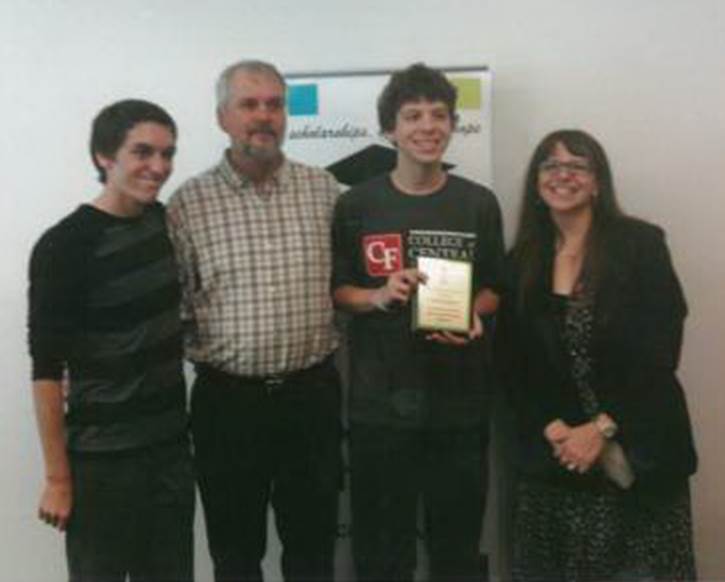
Wade McDonald at the Leaders 4 Life Award Presentation

Wade's brother Shane, father Blaine, Wade, and mother Joan


Friday, March 15, 2013

Congratulations!


TSIC High School Senior Wendall McGahee and TSIC Program Director Jody Mackle

Take Stock in Children program director Jody Mackle and Fernandina Beach High School Take Stock graduating senior Wendall McGahee were presented Distinguished Service Awards by the Nassau County Community Development Corp on February 23 in Fernandina Beach. Given in recognition of Exceptional Leadership and Community Service, Ms. Mackle’s was for Education and Mr. Wendall’s for Youth. 
 
Under Ms. Mackle’s leadership since 2000, Take Stock Nassau has affected the lives of over 300 Nassau County youth providing scholarships, mentors and hope for a better future. 
 
Dubbed as "Mr. Wendall" by his classmates, Mr. MaGahee has served as class president for 3 years and is acknowledged in the community as a youth leader because of his involvement in many worthwhile activities. He will attend FAMU in August on his Take Stock scholarship where he plans to major in Political Science.
 
Congratulations to both "Mr. Wendall" and Ms. Mackle. We are proud to have individuals like you representing Take Stock in Children!

Happy AmeriCorps Week!

Happy AmeriCorps Week! AmeriCorps can mean a lot of things to many different people, whether it is volunteering, building park trails, working with homeless youth, or advocating for students, one thing is for sure – AmeriCorps members make an impact in their community.
 
Check out the grand prize winner in the 2010 AmeriCorps Video Contest:


Here at Take Stock in Children, our AmeriCorps term is definitely many of these things and more.  Everyday, students inspire us, challenge us, and encourage us to be better individuals, volunteers, and citizens.  We thank you for the opportunity to serve you in order to “Get Things Done!”

Tuesday, March 5, 2013

Game Changers - the Story of Mitchell Marcus

TSIC’s annual Leadership Summit kicks off tomorrow in Tallahassee, Florida and is all about “Game Changers in Education.”  A recent story about high school student Mitchell Marcus broke last week, and is a true Game Changer, one rich with leadership, inclusivity, and sportsmanship.  Check out this great video and read more from the Huffington Post below:


A special needs student from a Texas high school scored a basket in the final game of the season after a player from the opposing team gave up the ball.

Mitchell Marcus, a teenage student at Coronado High School in El Paso, Texas, is the team manager for the Coronado Thunderbirds and an avid basketball fan. During the last game of the season on Feb. 12, Marcus, who has a "developmental disability," was given the chance to play, according to Fox local affiliate KFOX 14 in El Paso. With 90 seconds left, Coach Peter Morales put Marcus into the game.

"Mitchell's a great shot," his mother Amy told KFOX. "He took his first shot and missed. It hit the rim. You just hear the whole crowd sighing. It went out of bounds and Franklin got it. We all knew that he wasn't going to have his chance."

Then, Jonathon Montanez, a senior at Franklin High School and a member of the opposing team, down by 10 points, tossed Marcus the ball. "Since we were down and there was only 13 seconds left, might as well give Mitchell his last shot," Montanez told KFOX.

Marcus finally scored, and the crowd went wild.

A video of the game and Marcus' basket went viral after being uploaded online.

CBS News correspondent Steve Hartnan knew he wanted to tell Marcus's story. "It's America at its best," he told the El Paso Times. "When I grew up, kids like Mitchell got picked on, and to see how far we have come along is touching. I get emotional thinking about it."

NBC Southwest station KTSM first reported on Marcus' story the day after the game, calling it "the play of the year."

"I was so happy then," Marcus said about his shot. "It made my night."

Over the past three years, Marcus has helped the Thunderbirds earn a No. 1 ranking in the city of El Paso.

Coach Morales spoke with ESPN's El Paso radio station, KROD, about Marcus's amazing experience.

"This kid is very very loyal to your program," Morales told ESPN radio. "He's dedicated. We've had kids that come to this program and play with us and this kid has been more loyal than some of those kids to us because he wants to be here."


Take Stock in Children commends Mitchell, his coach, and the other team for their great examples of leadership and dedication.  This story serves as an inspiration for our students to create a positive environment at home and at school that allows everyone to thrive.

Monday, March 4, 2013

Special Guest Laura Schroff to speak at Take Stock In Children's Leadership Summit 2013

This Week, Take Stock In Children will be having its 2013 Leadership Summit in our state's capital.  Every year, TSIC  goes to Tallahassee to tell our lawmakers how important our program is to not only the youth who receive Take Stock's services, but to their communities as well.  This year Take Stock In Children has the privilege of having former executive marketing, New York Times best selling Author and the prestigious Christopher Award recipient, Laura Schroff on the roster as one of the distinguished speakers.


Laura's book, " An Invisible Thread: The True Story of an 11-year-old Panhandler, a Busy Sales Executive, and an Unlikely Meeting with Destiny " is a tale of two people whose life circumstances brought them together on a journey through adversity, triumph, tenacity and resilience.  

Laura and her mentee, Maurice Mazyck's story capture the very essence of the many mentor/mentee relationships that are formed within the Take Stock In Children family.  We look forward to hearing Laura's example of how she too is paying it forward!


Place link in your browser to watch her interview

http://www.today.com/video/today/50267753#50267753


Tuesday, February 26, 2013

Alternative Spring Breaks!

 
With Spring Break coming up in the next few weeks, we thought we would offer our students a way to engage in volunteerism while taking a break from studies. Alternative Spring Breaks are trips where a group of college students engage in volunteer service that focus on a particular social issue such as poverty, the environment, or education reform. Students learn about the social issues and then perform week-long projects with local non-profit organizations. Alternative breaks are great because you get to travel and work with a group of peers for a week, all while creating an impact in the community!

What you stand to gain
·         Travel You can travel to new communities and meet new people
·         Involvement These trips are great ways to become more involved in school and in your community
·         Savings Alternative Breaks are often considerably less expensive (if not totally free, covered by student government) than traditional Spring Break trips
·         Experience Serving with an Alternative Spring Break is a great way to gain leadership experience

Quality components of an Alternative Break
Strong Direct Service: Should provide an opportunity for participants to engage in direct or “hands on” projects and activities that address unmet social needs, as determined by the community.

Orientation: Alternative breakers learn about the purposes and goals of their community partners with which they will be working.

Education: Breakers learn about the complexity of the social issue through reading materials, speaker panels, documentaries, and guest lecturers related to current trends and historical context. A strong educational foundation for the trip will contribute to a meaningful service experience.

Training: Breakers are provided with adequate skills necessary to carry out service projects during their trip. This may include learning physical skills, such as construction or maintenance skills, as well as interpersonal communication, such as interacting with children, sensitivity training, working with people with disabilities, trail building, etc.

Reflection: During the trip participants process the service work as it connects to the broader social issue. Groups set aside time for reflection to take place individually and as a group.

Reorientation: After students return to campus, reorientation activities allow participants to talk about issues with others on campus, learn about local volunteer and civic involvement opportunities, and brainstorm other means to benefit their local community. Reorientation (the post-trip application of the experience) is the essential purpose of an alternative break - to provide a platform for participants to work towards lifelong active citizenship.

Diversity and Social Justice: Strong alternative break programs include diverse representation of students from the campus community and direct exposure to studying social justice issues
Impact
Many students who return from an alternative break experience consider it a life changing event. Alternative break alumni have reported changing their major, increasing their campus involvement, committing to continued community service, actively staying updated on social issues, and joining a service program post-graduation such as AmeriCorps, Peace Corps, or Teach for America. Many return to participate and lead alternative break programs throughout their time as students.

An impact analysis conducted in 2001 by Dr. Pushkala Raman and her Marketing Research Class at Florida State University in conjunction with Break Away (www.alternativebreaks2013.org) revealed that there is overwhelming evidence to support the view that alternative breaks are “indeed contributing to the creating of active citizens.”

Many schools coordinate Alternative Spring Breaks for their students, so if you are interested in taking part in a trip this spring, check with your Student Government or Community Outreach office.  You may also want to check out the following link for more organizations which offer their own Alternative Spring Breaks:  studenttravel.about.com/od/springbreakvolunteers/qt/alternate_sprin.htm